Every echo is a guess until you've seen it fished. These are the patterns owners learn first. The screens are real Furuno captures.
Bait
Bait reads as a wide patch with soft, ragged edges, mostly in the cooler blues and greens with warmer cores where it is densest. It changes shape from ping to ping as the fish move and compress. Watch the edges: predators working a bait school often show as harder marks cutting along or through it.
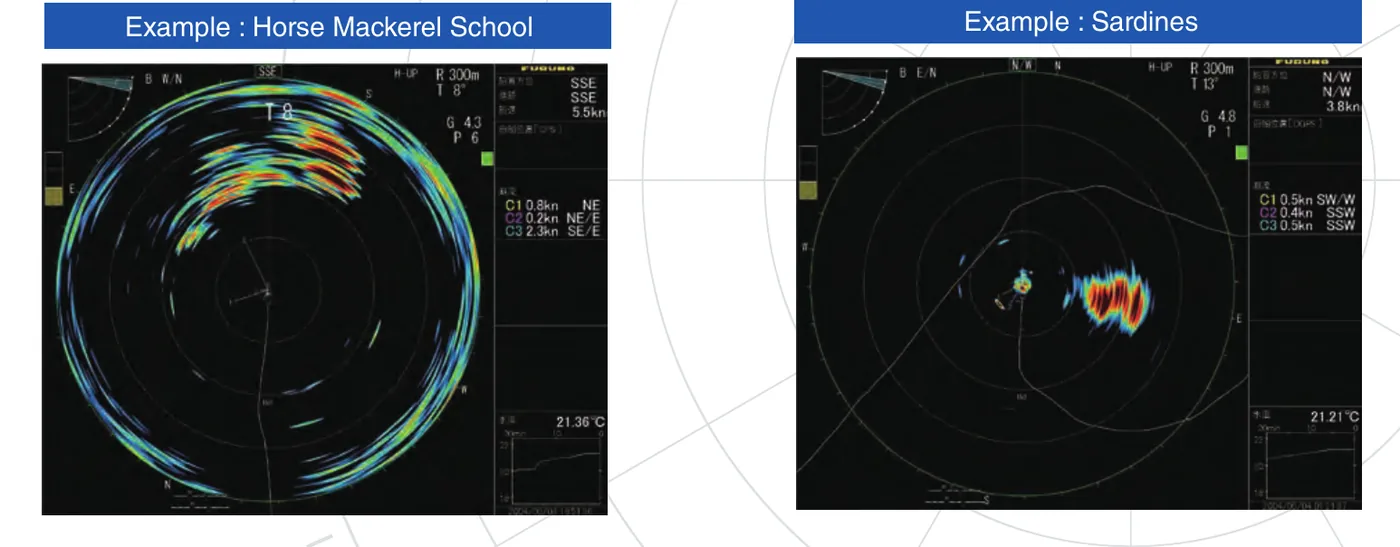
Tight schools
Schooling fish such as tuna show as compact, strong marks that hold together and move with purpose, usually faster than bait. Target lock is made for these: on the CSH-10 it reports the school's distance, depth, speed and course, which tells you where to set up.
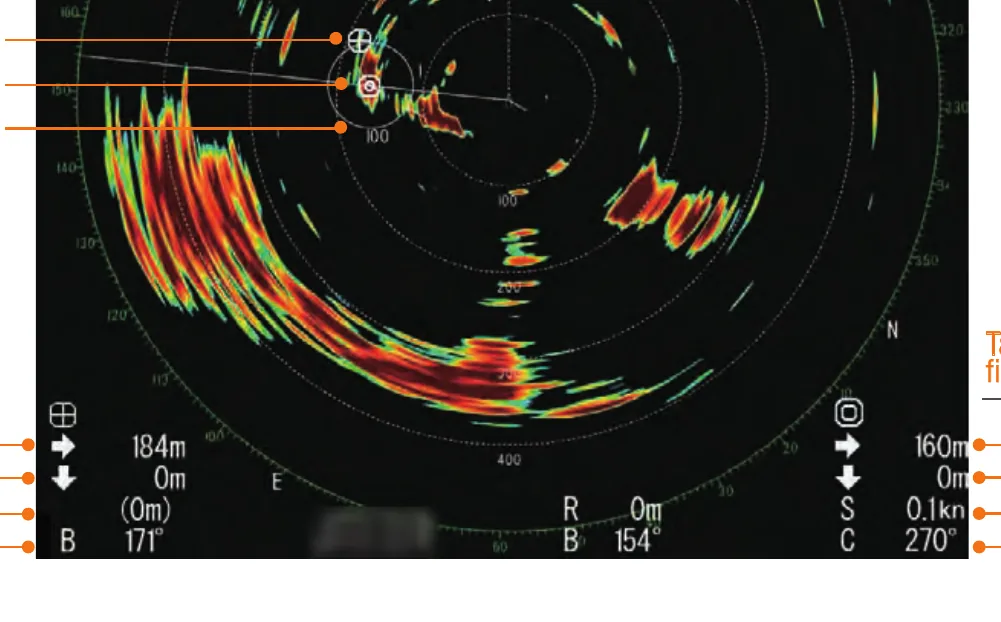
A single fish
A single large gamefish is a small, hot mark that moves on its own, separate from the bait. It may show for only a few pings. Capt. Steve Lassley's warning: look away for three or four seconds and you can miss it entirely. Capt. Ken Blackman's habit when one disappears: circle and search in different directions. In the 2021 Mississippi Gulf Coast Billfish Classic that habit turned one lost mark into two blue marlin and then a bigger fish.
The seabed
The bottom is the ring that stays fixed to the chart while the boat moves. Its distance tells you your tilt is doing what you think. See tilt and the beam.
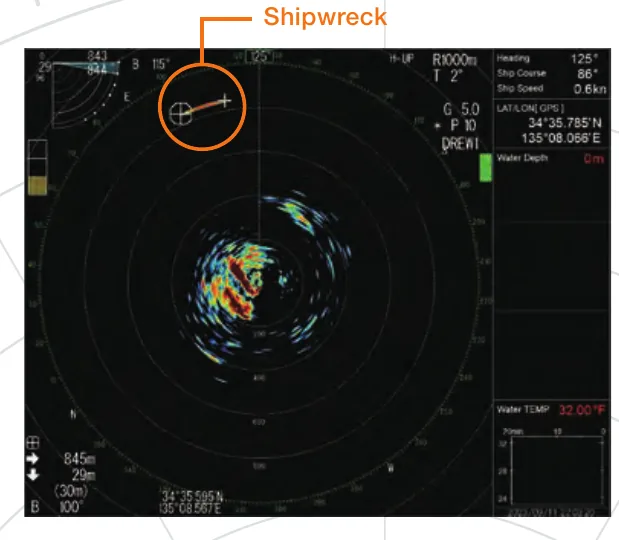
Wrecks and structure
Hard structure gives a strong, stable echo that doesn't drift. Furuno's CSH-10 brochure shows a 40 m wreck clearly at about 850 m. Event marks and target mark mode hold structure in place while you work it.
Wake, rain and clutter
Prop wash and your own wake paint close to the boat and behind it. Rain makes surface noise that looks much like wake, according to dealers. In a sea, waves under the hull add clutter, especially at low tilt. Clutter flickers and doesn't move with purpose; fish do.
Other boats
Boats nearby running the same omni model on the same frequency can paint each other's pings as regular patterns. What to do about it.
Rules of thumb from the bridge
- Don't chase every mark. Find your species' school, its edges and its direction. (Capt. Brandon Walton)
- Pair omni with a conventional sounder: omni covers area and direction, the sounder is better for species and size. (Walton)
- Spend time on the screen learning how fish and marine mammals look different. (Capt. Rich Barrett)
Captains' accounts from InTheBite, February 2024; clutter notes from the InTheBite dealer round table.