How omni works
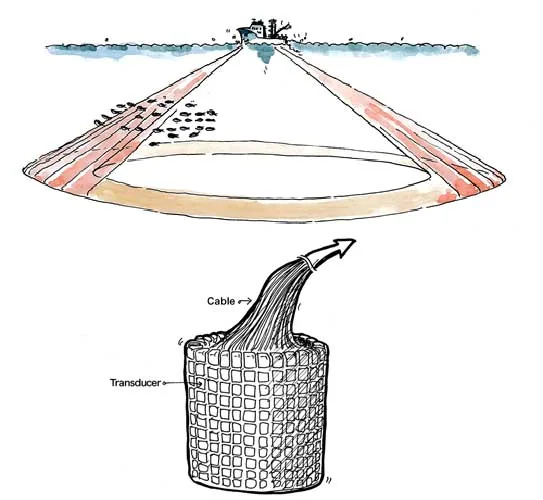
A scanning sonar transducer is built from many small elements arranged so that each faces a slightly different direction. Furuno describes the transducer in its scanning sonars as roughly a thousand oscillators in vertical and horizontal grids. Because they all fire together, the sonar sends sound in every direction at once and listens on every bearing at once. Nothing rotates.
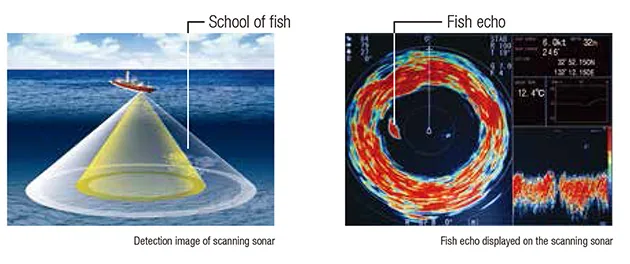
Each returning echo is placed on the display by its bearing and its distance, so the picture is a disc with your boat at the center. Bait shows as broad, soft-edged clouds, schools as tighter, stronger blobs, and a single large fish as a small, intense mark that moves against everything else.
That is the whole advantage: the same school gets painted again and again from every side, so you can see where it is heading and how fast, instead of finding it once and losing it.
Searchlight vs omni, at Furuno's published speeds
A searchlight sonar steps its beam 6° at a time and needs 32 seconds to go all the way round at 400 m. The CSH-8L MK2 redraws the whole circle every 0.54 seconds. One fish is swimming around the boat. Press start.
How long does an echo take?
Sound travels through seawater at roughly 1,500 meters per second, a little faster in warm, salty water and slower in cold or fresh water.
Omni compared with the other sonars on your boat
| Type | Where it looks | Best at |
|---|---|---|
| Fish finder (sounder) | Straight down in a cone | Depth, bottom, fish directly under the boat |
| Searchlight sonar | One narrow beam, stepped around the circle | Long-range looks in a chosen direction; slow to cover the full circle |
| Multibeam / forward-looking | A fan ahead of or beneath the boat | Detailed bottom and bait under and just ahead |
| Omni (full-circle scanning) | All 360°, every ping | Finding and following moving fish hundreds of meters away on every side |
Tilt, the control that matters most
The omni beam is shaped like a shallow cone that you tip down toward the water. On the CSH-10 the transmit beam is 6° tall. Tilt sets how far below the horizon the middle of that cone points.
At a low tilt the beam travels far and stays shallow, so you see the surface layer a long way out. At a higher tilt it angles down sooner, so you see deeper water closer to the boat. Where the beam reaches the seabed you get a bright ring around the display, and that ring moves in as you add tilt. The display on the home page shows exactly this.
Where is my beam?
Straight-line geometry: horizontal distance = depth / tan(tilt). Real beams bend a little with water temperature layers.
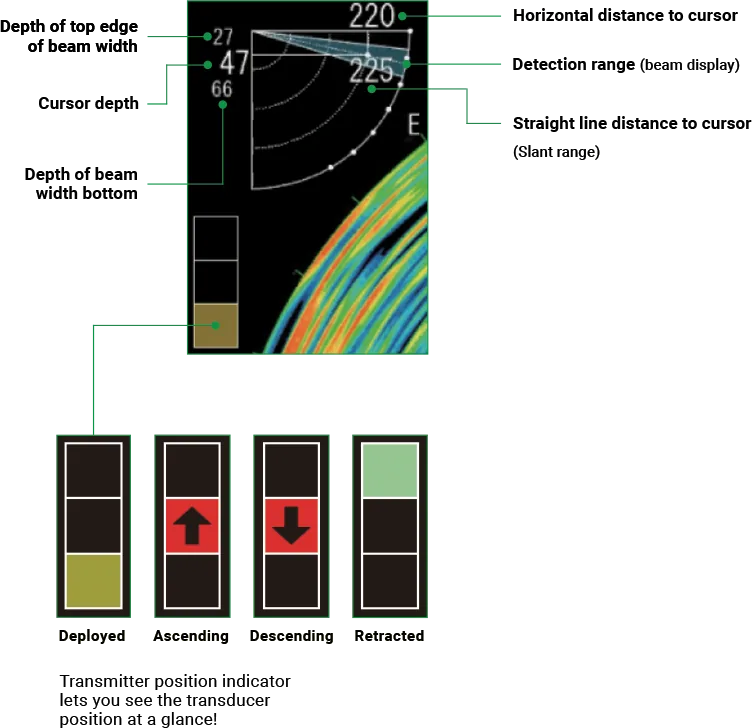
The CSH-10 shows this on screen with its tilt indicator: put the cursor on an echo and it reports the straight-line, horizontal and vertical distance, plus the depth of the top and bottom edges of the beam at that point.
Why 85 kHz
Lower frequencies reach farther; higher frequencies draw a sharper beam. Furuno puts its sportfishing omni at the higher end, about 85 kHz, because a narrow beam separates fish from the bottom and from surface clutter and makes small, fast targets easier to pick out. The CSH-10 transmits at 83.5 kHz by default and can move between 81.5 and 85.5 kHz.
Limits worth knowing
- Speed. The CSH-10 is rated to 20 knots with the transducer down and 18 knots while it moves. Boats that cruise above 25 knots need a fin ahead of the tank, according to Furuno's installation notes.
- Interference. Two boats near each other on the same omni and frequency can paint each other's pings. What to do about it.
- Motion. In a sea, the boat's roll swings the beam up and down. Both models correct for it with a motion sensor: the CSH-1042 on the CSH-10, and the MS100 that Furuno USA includes with the CSH-8L MK2. The CSH-10 stabilizes its transmit and receive beams independently. See stabilization.
- Learning curve. The crews who get the most from omni spend hours watching the screen. Start with the tutorials.
Questions
What is omni sonar?
Omni (omnidirectional) sonar is a scanning sonar whose transducer transmits in all directions at once and receives echoes from the full 360° circle on every ping, so the whole area around the boat is redrawn continuously instead of one bearing at a time.
How far can a Furuno omni see?
Furuno rates the CSH-10 for detection up to 900 m (over 2,900 ft), and its range scales run from 50 m to 2,000 m. The CSH-8L MK2 has range scales from 50 m to 1,600 m. Real detection depends on target size, sea state, gain and tilt.
What frequency does Furuno omni use?
The CSH-10 transmits at 83.5 kHz, selectable between 81.5 and 85.5 kHz. The CSH-8L MK2 transmits at 85 kHz. Furuno describes this as a mid-to-high frequency that gives a sharp beam and good separation of fish from the bottom and from surface clutter.
Is omni sonar the same as forward-looking or multibeam sonar?
No. Forward-looking and multibeam sounders image a fan in front of or beneath the boat. Omni scans the full circle horizontally around the boat and reaches hundreds of meters out, which is why it is used to find fish rather than to see the bottom in detail.
Can I run omni at cruising speed?
The CSH-10 is rated for use up to 20 knots with the transducer down and 18 knots while raising or lowering. The CSH-8L MK2 is rated to 18 knots, 16 knots while raising or lowering. Above that, retract the transducer.
What sensors does omni need?
The sonar runs on its own, but heading, speed and course data unlock north-up display, target lock tracking and fish school speed and direction. Both stabilize their beam with a motion sensor: the CSH-1042 is standard on the CSH-10, and Furuno USA includes the MS100 with the CSH-8L MK2.