The shape of the beam
An omni beam goes all the way around the boat but is only a few degrees tall: on the CSH-10, 6° between its half-power edges. Think of a shallow cone, opening downward, with the boat at its tip. Tilt sets how far below the horizon the middle of that cone points.
Because the beam is thin, a few degrees of tilt moves it a long way at range. At 600 m out, every degree of tilt shifts the center of the beam about 10 m in depth.
Where is your beam?
Side view of the CSH-10's 6° transmit beam. Move the sliders and watch where the beam goes, where it meets the bottom, and whether the fish is in it.
The seabed ring
Wherever the beam meets the bottom, the bottom echoes back hard. Because the beam goes all the way around, that contact forms a ring on screen. Its distance is the bottom depth divided by the tangent of the tilt. Add tilt and the ring moves in; take tilt out and it moves out, until at very low tilt the beam never reaches the bottom on your range.
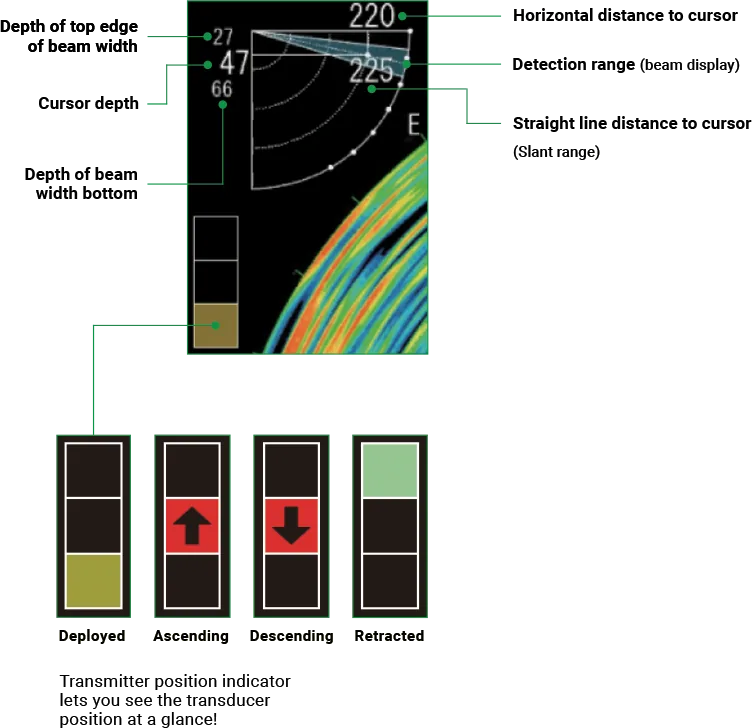
Tilt in practice
Captains who run omni in tournaments describe tilt as the control they touch most. A few habits come up again and again in their interviews with InTheBite, February 2024:
- Work the surface in calm water. Capt. Steve Lassley of Bad Company uses as little tilt as he can for striped marlin, sailfish and white marlin in calm conditions.
- Rough water and low tilt don't mix. Capt. Rich Barrett of Shark Byte found that at 10 to 12° of tilt on a boat rolling 10 to 12°, waves fill the screen with clutter from underneath. See stabilization.
- Confirm marks by rocking the tilt. A fish brightens and fades as the beam passes through its depth. Surface clutter and wake don't.
When the water bends the beam
Sound doesn't always travel in straight lines. A thermocline, where temperature changes quickly with depth, bends the beam and can shorten detection range, according to dealers at an InTheBite dealer round table. They also note that lower salinity improves performance. In green water or a strong thermocline, Capt. Lassley adjusts AGC and echo average rather than fighting it with gain alone.