Every captain who runs omni well says some version of the same thing: it only pays if someone is watching it. InTheBite's interviews with tournament captains running Furuno's 8L describe a learning curve measured in hours of screen time, and the payoff of seeing fish long before they reach the spread.
Screen time beats settings
The crews who get the most from omni put someone on it full time. With practice, that person starts to tell bait from gamefish by how the marks move, not just by color: a single strong target cutting across a bait patch looks different from the patch itself.
Callouts
"One mark" is a common call: one fish, on this bearing, this far out. A consistent callout lets the helm turn toward it and the cockpit get ready without anyone leaving their station. The CSH-10's wireless remote, up to four on one system, means the person calling marks doesn't have to stand at the helm.
Tilt discipline
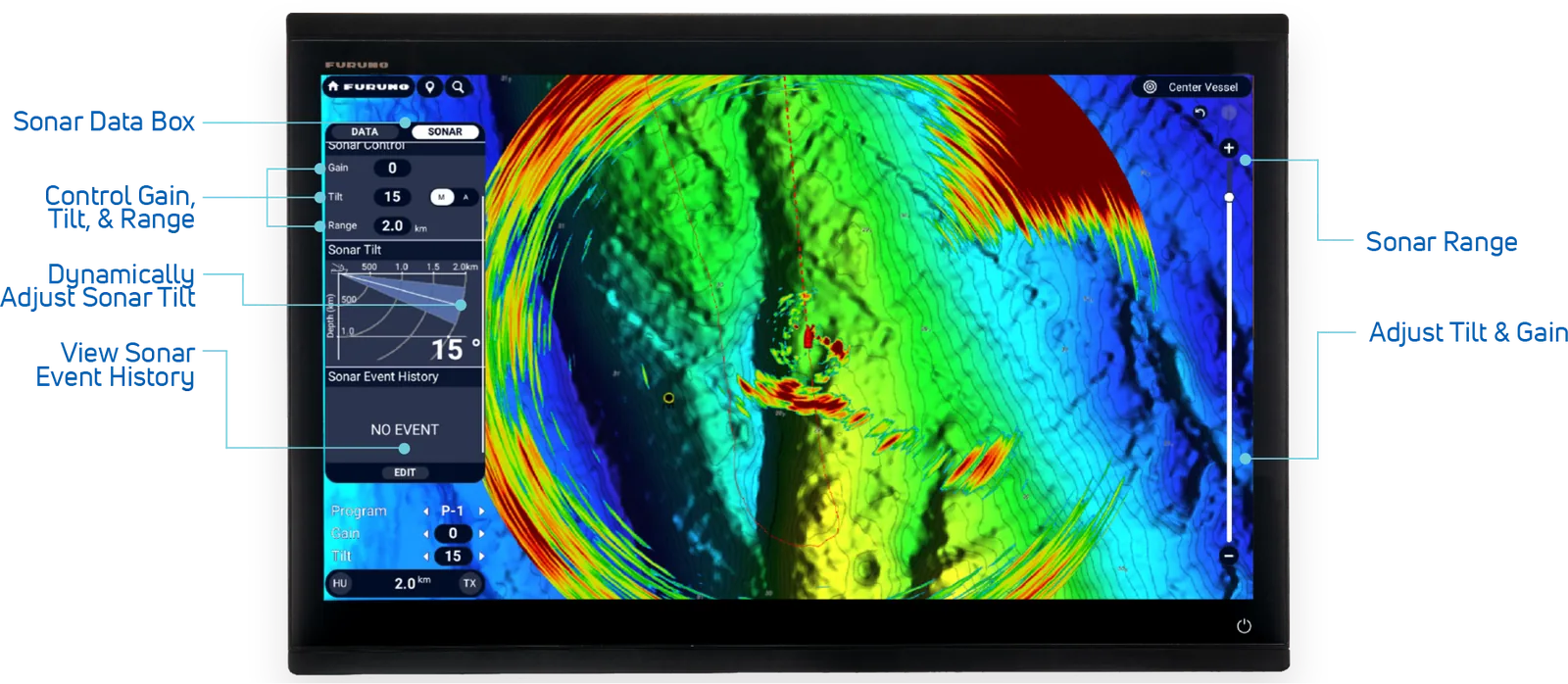
Set a working tilt for the depth you expect fish at, then rock it a few degrees around that to confirm marks. It's the fastest way to tell a real fish from noise, and on the CSH-10 the tilt indicator shows the depth of the beam at your cursor.
Slow down when it matters
Matt Wood of Furuno has suggested 10 to 15 knots while searching and 2 to 8 knots once lines are in. Slower boats are quieter boats, and quieter boats paint better.
Integrated helms
On the CSH-10, NavNet TZtouchXL can overlay sonar echoes on the chart, so a school's position is seen against the contour it's following. InTheBite's 2026 coverage of tournament crews singles out that integration as a real edge.
Published 2026-10-31. Sources: Furuno CSH-10 and CSH-8L MARK-2 brochures, Furuno USA product pages, InTheBite, Yachting and Power & Motoryacht.