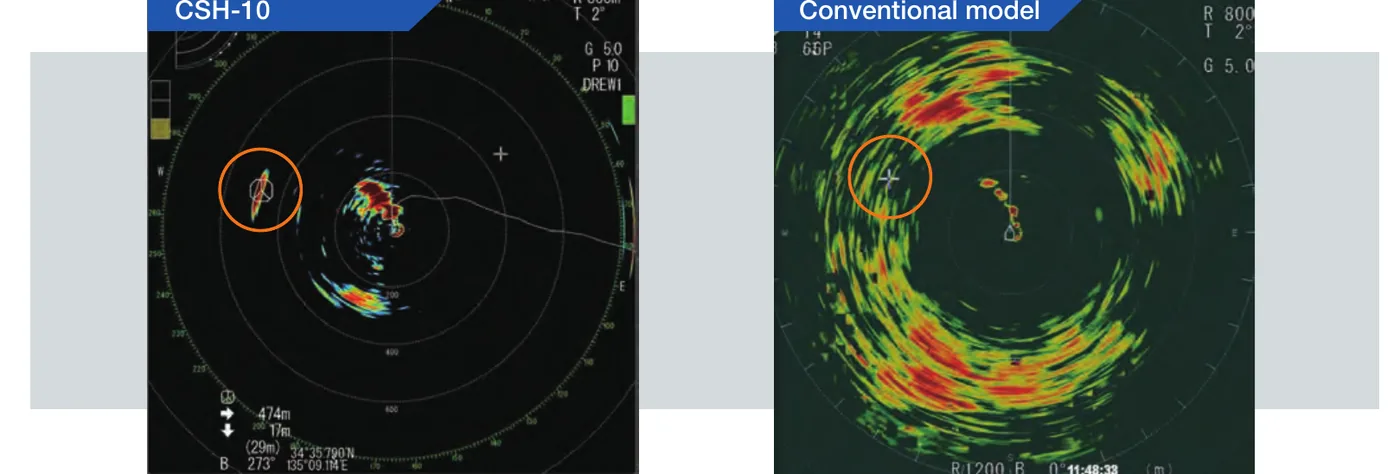
Both tools put a beam in the water and listen. The difference is how much of the ocean they cover per ping. A searchlight sonar aims a narrow beam, listens, steps about 6 degrees, and repeats: roughly 32 seconds to sweep the full circle at 400 m. Furuno's omnis transmit the whole 360 degrees at once; the CSH-8L MK2 redraws the entire circle every 0.54 seconds.
The math at search speed
At a 10-knot search you cover about 165 m between a searchlight's full sweeps. A fish that crosses a sector while the beam is elsewhere is simply never painted, and a mark you do get is half a minute stale by the time the beam comes back to confirm it. An omni repaints the same fish about sixty times in that window, which is why marks develop into tracks you can steer on instead of single flashes you argue about.
What that buys a tournament boat
Finding fish before they reach the spread is a bearing-and-distance game. The omni picture updates fast enough to call “one mark, port bow, 300” and still be right when the helm comes around. With a searchlight, by the time the beam revisits the bearing, the call is history.
When a searchlight still makes sense
Smaller boats without room for an 8-inch hull tube and a tank, budgets a long way from omni money, and single-beam jobs like tracking one bait school at slow speed. A searchlight is also a simpler install. It is honest kit; it is just not a search tool at sportfish speeds.
The numbers
Furuno USA publishes the CSH-10 system at $91,095 and the CSH-8L MK2 at $79,075, both less hoist, shaft and cables. Total your exact stack in the price builder, then let four questions settle the model. The free lessons cover how the circle actually gets painted.
Published 2026-11-02. Sources: Furuno CSH-10 and CSH-8L MARK-2 brochures, Furuno USA product pages, InTheBite, Yachting and Power & Motoryacht.