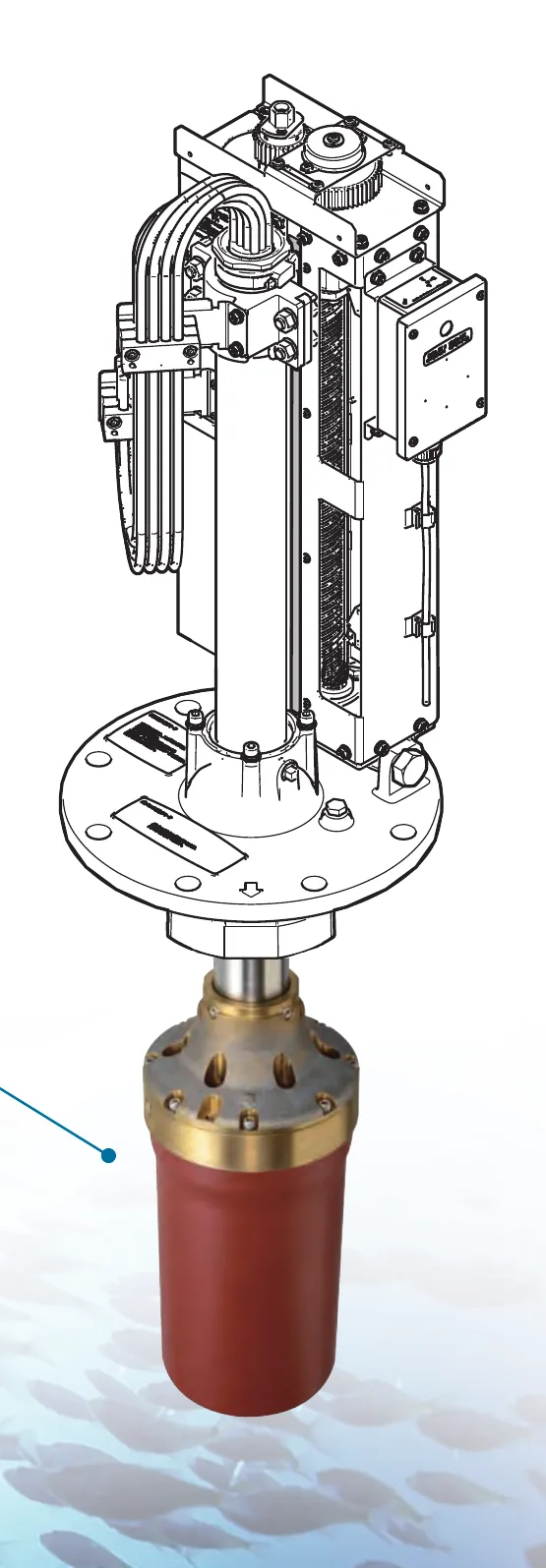
Price an omni and the electronics are the easy half: Furuno publishes every number. The part nobody can print is the tank, because Furuno doesn't sell it. The transducer retracts into a fabricated tank inside the hull, behind an 8-inch hull tube, and that structure is designed and built by your yard for your boat.
What the tank does
It gives the transducer somewhere to live at speed, holds the hoist that raises and lowers it, and ties the whole assembly into the hull structure. The published pieces around it: hull tube at $1,767 per meter in steel or $2,653 in FRP ($1,767 to $6,233 across the catalog), and a hoist with 400 mm or 600 mm of travel, which sets how tall the tank and the space above it must be.
What drives the cost
- Hull material and access. Cutting, bracing and glasswork in a cored FRP hull is a different job from welding in metal, and a tight machinery space adds hours everywhere.
- Position. On the keel centerline, 400 mm of travel usually clears the hull; off-center tanks typically need 600 mm to get the transducer below the keel's shadow. The fit checker walks the measurement.
- Speed. Boats capable of 25 knots or more get a fin ahead of the tank, and small FRP hulls an optional fairing; both are shaping and finishing work.
- Haul-out time. The boat is out of the water for all of it.
Why installed quotes vary
At a dealer round table covered by InTheBite, typical installed omni projects landed around $110,000 to $120,000 all-in. The spread between quotes is mostly tank and yard time, not electronics, which is why two identical electronics orders can be $15,000 apart honestly.
Who builds it
A yard that has done omni tanks before is worth real money. The vendor directory lists installers and yards by region, and a quote request reaches a licensed, insured, certified and Furuno-approved dealer network that will scope the tank with your yard.
Published 2026-11-02. Sources: Furuno CSH-10 and CSH-8L MARK-2 brochures, Furuno USA product pages, InTheBite, Yachting and Power & Motoryacht.